
The Million Year Picnic by Ray Bradbury
Here we are… it’s Wednesday again, and it’s time to catch up with my eighth graders; they are always hard at work, always looking to broaden their scope of knowledge, and always looking for the next debate. They love to disagree… always.
I have to tell you that this was not today’s short story, and I guess I have to fill you in on a little secret. I am about a week late here; always living life just a bit behind and admittedly enjoying the fact that when it comes to some things… I can be late and not worry about having to punch a clock. There are so many other things to do, and although I truly love to write, I love other things more!
A few weeks ago, we journeyed into Ray Bradbury’s, The Veldt. The kids loved it, and because they’ve asked, and because I am a pushover for letting them roll with the things they enjoy, Ray Bradbury is back, and we’ve once again delved into this author’s futuristic visions that somehow don’t seem to be quite as futuristic as they did during the time in which they were written. The Million-Year Picnic; what is it? Why would anyone plan a picnic that would engulf not just one lifetime but thousands? Why would a family travel to a destination light moments away? Why would they have to? Is it a necessity, or is it just another day? Let’s find out.
“Don’t think. Thinking is the enemy of creativity. It’s self-conscious, and anything self-conscious is lousy. You can’t try to do things. You simply must do things.”
Ray Bradbury
Ray Bradbury
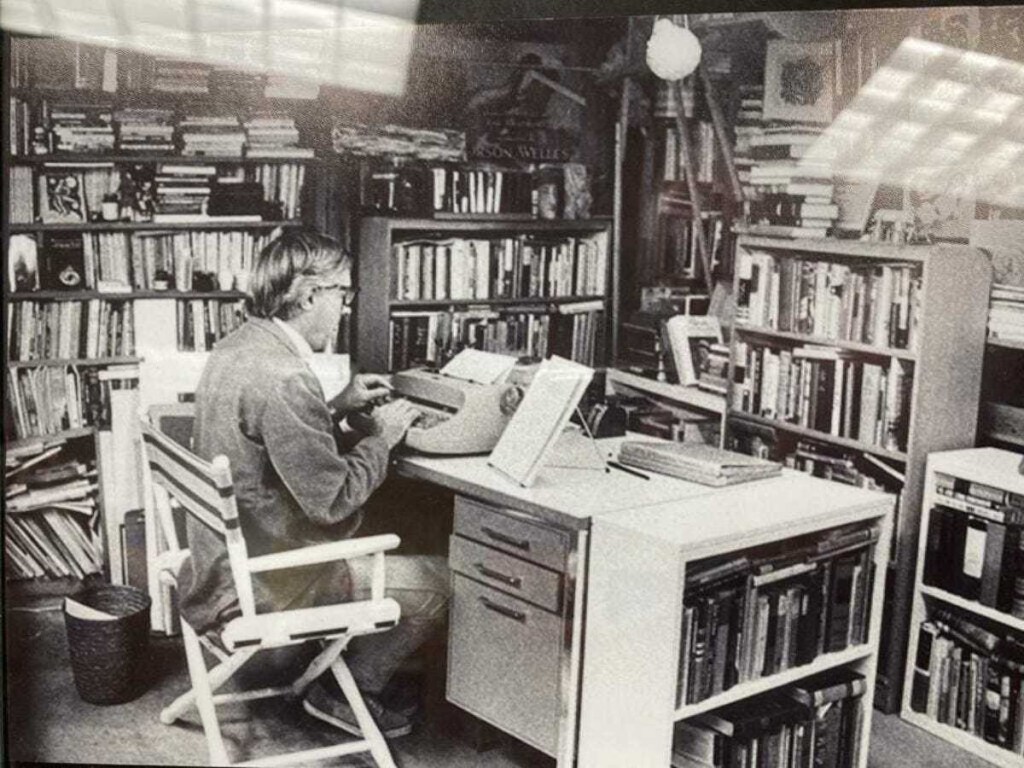
Since I have already given you a glimpse of Ray Bradbury’s views on technology, and his reasons for questioning technology’s effect on the family unit in my introduction to The Veldt; I will not repeat myself here and take the chance of boring you. Bradbury’s novels are not only creative but are also used as a personal forum to address modern day issues and to make observations on the way we live today. The following words are Bradbury’s own. They encompass his views on education, and they should serve to humble the educator. If we love our students… we should take them to heart.
In a nutshell…
“The main problem is with our education, of course. First-grade teachers for many years now have not been teaching reading and we have to encourage them to pull up their socks and begin to pay attention so that the whole school system doesn’t go to hell. People are getting into high school who can’t read. It’s stupid, isn’t it? It’s crazy.”
“The jails are full of one million non-readers. We can’t let it happen again. If you allow another generation to grow up to be 12 years old…. without the ability to read, write, and think, we’re sunk. If they can’t read, if they can’t write, if they can’t think, they become criminals. We’ve already lost two generations. Unless we teach reading intensely and completely in kindergarten and first grade, the whole civilization goes to hell.”
“With computers, kids can connect and search libraries and the Encyclopedia Britannica, but if you don’t teach them to read in the first place, they’re not going to [log on], are they?” (Speech to National School Board Association, 1995)
And then, we have his thoughts on life and getting older, as on the occasion of his 80th birthday in August 2000, Bradbury said, “The great fun in my life has been getting up every morning and rushing to the typewriter because some new idea has hit me. The feeling I have every day is very much the same as it was when I was twelve. In any event, here I am, eighty years old, feeling no different, full of a great sense of joy, and glad for the long life that has been allowed me. I have good plans for the next ten or twenty years, and I hope you’ll come along.”
The Million Year Picnic

Emotional Journeys
The million year picnic begins as a trip. It isn’t forever, it isn’t anything that is seen in any other way than the way in which it has been addressed… it’s a fishing trip, but is it? The trip was Mom’s idea, but why mom? Why would she want to go fishing? Dad, on the other hand, seems nervous. His hands are trembling, he shuffles his feet, he has a hard time looking his children in the eye and questioning looks are shared between him and his wife. Their oldest son Timothy watches them both with eyes that also question, eyes that are also young enough to hold curiosity.
Timothy remembers the trip from Earth. He remembers the night before they left, and he remembers the negative undercurrents that accompanied the packing… the rushed hurrying of unplanned spontaneity. Where had his father found the rocket? Why travel so far away? Why Mars? Timothy had kept silent. He’d questioned nothing in his desire to not to worry his brothers, but that didn’t mean that he didn’t have questions, it just meant that he hadn’t voiced them out loud.
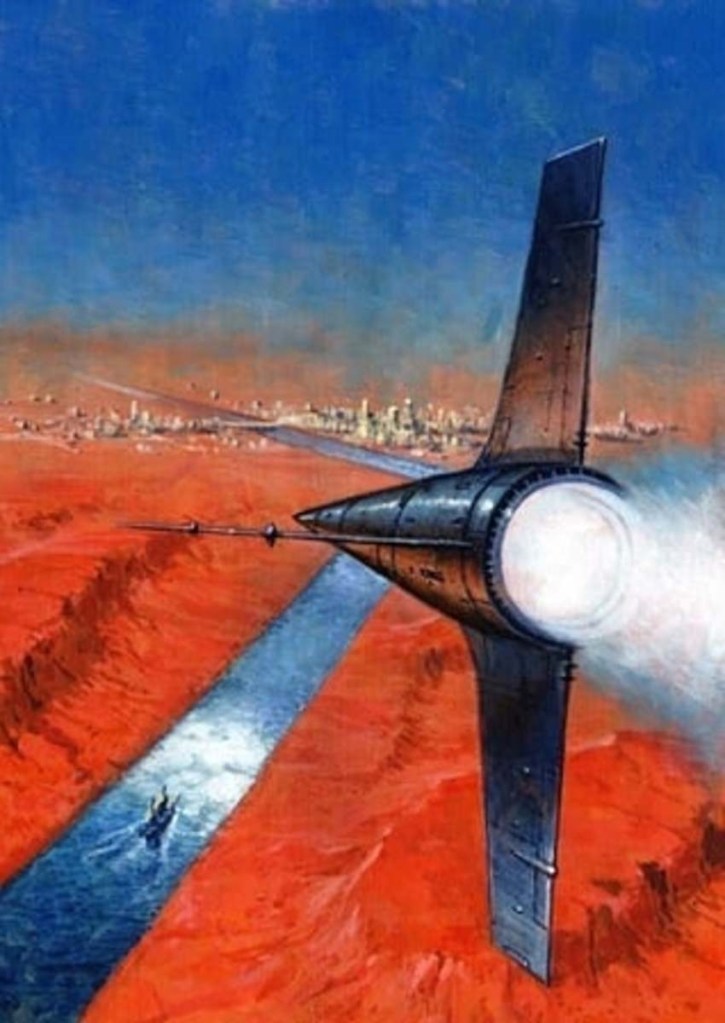
Their arrival on Mars finds them at the beginning of a journey. The two younger brothers are ready to fish, but Timothy senses that their presence in the water boat and their departure down the canal is more than what he’s been told. He holds onto his father’s hand, and he watches the changes in his father’s face… a look in his father’s eyes that he has never seen before, a look that isn’t easy to decipher, but also a look that doesn’t alarm him. The look he sees is reassuring, but why does this look ease his fears, and even more importantly, why was his father afraid? What has happened in the lives of these five people that forced them to take this trip to Mars, and are they the only ones making this fateful trip? Are there others, and if so, where are they?
Timothy breathes in his father’s obvious sense of relief at their safe arrival, it calms him, but he continues to watch his father’s face while listening to the sounds of the violet water splashing against the sides of the boat. He relaxes even more as he observes how the lines in his father’s face are changing before his eyes… crevices caused and deepened by worry and apprehension are slowly transforming themselves into the lines of long-lost smiles.

The Discussion
Another story by Ray Bradbury was specifically requested by my students, and their request couldn’t have come at a better time, as Bradbury’s work enabled us to continue a discussion that had already begun. A Million Year Picnic was my own personal choice, and it was chosen to make them think. What is it that we are really afraid of, and if we’re scared, what will it take to alleviate our fears? Who is responsible for the situations we find ourselves in? Who and what protects a nation from fear, and who do we trust to make decisions for what are our lives? Do we trust anyone? Have we lost trust, and what will it take to get it back? The following quotations have already been mentioned in the summary, but these quotations are what became the basis for our discussion; “I was looking for Earthian logic, common sense, good government, peace, and responsibility.” His son asks, “All that up there?” To which the father responds, “No, I didn’t find it. It’s not there anymore. Maybe it’ll never be there again. Maybe we fooled ourselves that it ever was there,”
The belief in the existence of Earthian logic is well and alive in our twelve and thirteen year old children. They concede that there are great men and women… men and women who possess great minds, compassion, empathy, vision, understanding, and the ability to use those gifts for the good of the whole. The American people. That our country feels as if it’s on a shaky path was agreed upon unanimously by the students, that we have reason to fear for our futures was also a majority rule decision. There was no debate that we are in trouble both as a country and as citizens of this planet, but they also have faith that if the people with power choose to use it in the right way, with good intentions, we can make it. They firmly believe that things can be better, that they can get better.
Common sense and good government did not receive the same vote of confidence. There was much discussion about our government’s “posturing” for the media, for the people who watch. Posturing was not my word, but it was used by the children, and that’s how they perceive our government officials. They specifically noted several members of Congress (who will remain unnamed) that they consider to be fabulous orators, socializers, and ambassadors… great to watch on social media, but unrealistic in the capacity of government leaders. They do not see these overly loud and demanding officials as people who are leading a country, but rather, people who are looking for attention. They believe that too many decisions are made on the basis of what looks good, and the things that in all reality are good; they are put aside to suit the roles our officials have decided they want to fulfill. They see their government officials as having a great presence that is partnered by a lack of substance. They left me speechless.
Peace is their greatest desire. Talk Middle Eastern politics with a group of middle schoolers; discuss the wars that have continued and repeated themselves for thousands of years and all for the same reason. Their immediate response is, “We were told to share in preschool. Why can’t adults learn to share?” We talked about religion and the way that one specific city is claimed by many religions, but why it can never really belong to any one of them. We talked about the privileges we take for granted… the church over there, the mosque in the city, the cathedrals, the temples, the freedom of religion we hold as God given rights.
Natural resources, shortages… wars over oil, the probability of water someday holding that same value and provoking the same results. Peace is desired and unrest is inevitable, but how do we encourage the world to place the same values on the invaluable. How do we get the population of the Earth to hold morality and values as what is most important. Who is responsible for what could be a “global education,” and why doesn’t anyone want to take on the responsibility of just standing up and saying, “this just doesn’t work anymore; we are all responsible.” Where’s the common sense, and won’t the use of common sense bring us peace? I can’t answer that, but I did listen. I think we should all listen.
There was a bright spot though, a moment of positivity, as my students proclaimed the father wrong, someone was giving up on the goodness of humanity. They believe that the things he searched for while looking back at the Earth he’d fled with his family had existed. They saw him as having given up, but they also saw what he’d done for the good of his family as the right thing. They saw him as a man who embodied Earthian Logic, as a visionary, and that his vision had taken him and his family on the million-year picnic that would enable him to do it all over again, the right way.
The Reality
Watching the rocket disappear behind them, the family moves on down the river. The younger boys ask, “How far are we going? How long until we get there?” The same questions asked by children everywhere at the outset of a family road trip, but this is not a “normal” family vacation, and the father responds that they are traveling, “a million years.”
Their ride down the river reveals cities, but the once thriving cities are now dead and deserted. The father looks pleased; he’s obviously happy they’ve been abandoned, but why is he happy? Why is he visibly pleased at the sight of desolation and emptiness? A bird flies nearby, and the father is startled. He explains that he believed the bird to be a rocket, and he seems to be frightened.
Traveling along the family looks towards home, searching the sky for a glimpse of Earth… the war torn cities they’d left behind. The father once again looks sad, nostalgic, and then he looks away to the empty, pink horizon that lay before them. Timothy senses his apprehension and asks why he is looking so hard… what is he looking for. His father responds, “I was looking for Earthian logic, common sense, good government, peace, and responsibility.” To which his son asks, “All that up there?” To which the father responds, “No, I didn’t find it. It’s not there anymore. Maybe it’ll never be there again. Maybe we fooled ourselves that it ever was there,” and he finishes by pointing out a fish nearby in the river.
Further on they find themselves looking for Martians, but there is no evidence of their existence. The planet is empty, empty but for the family that has traveled there because their planet and the world they lived in no longer exists. The boys are entranced by a silver ring fish floating near the edge of their boat; they watch its actions, and the father responds by comparing the fish to the ravaged world they’d left for what three children had believed was a fishing trip. His comparison, “Just like war. War swims along, sees food, contracts. A moment later- Earth is gone.” What does this mean?
The children continue to look for Martians… Martians that their mother claims to be a dead race, and their father says, “Maybe tonight.” He doesn’t deny their existence. The boat continues to roll through the canal, each inhabitant wearing a different faces… Dad’s look is determined, whereas Mom’s look is resolved. It is what it is, a simple fishing trip, rockets, an endless supply of food hidden where they’d landed, a gun, and then suddenly out of nowhere an explosion. Everyone jumps. The rocket has self-destructed, and the father’s intake of breath signals relief, but the children are now overcome with questions. Only Timothy seems complacent; he seems to understand.
This is where we’ll leave off. If you want to know and understand Bradbury’s vision; you will need to read it for yourself. Is the family alone? Has anyone other than the father, once a state governor, seen the future and prepared? Will anyone else complete the journey? Has anyone else survived the end of the Earth, and if they have, will the generations of the future have learned from the mistakes of the past? Who are the Martians, and will they finally see them face to face? The answer to the last question; yes. Can you guess who the Martians are?
 History Belongs To Us
Leave a comment