What is History?
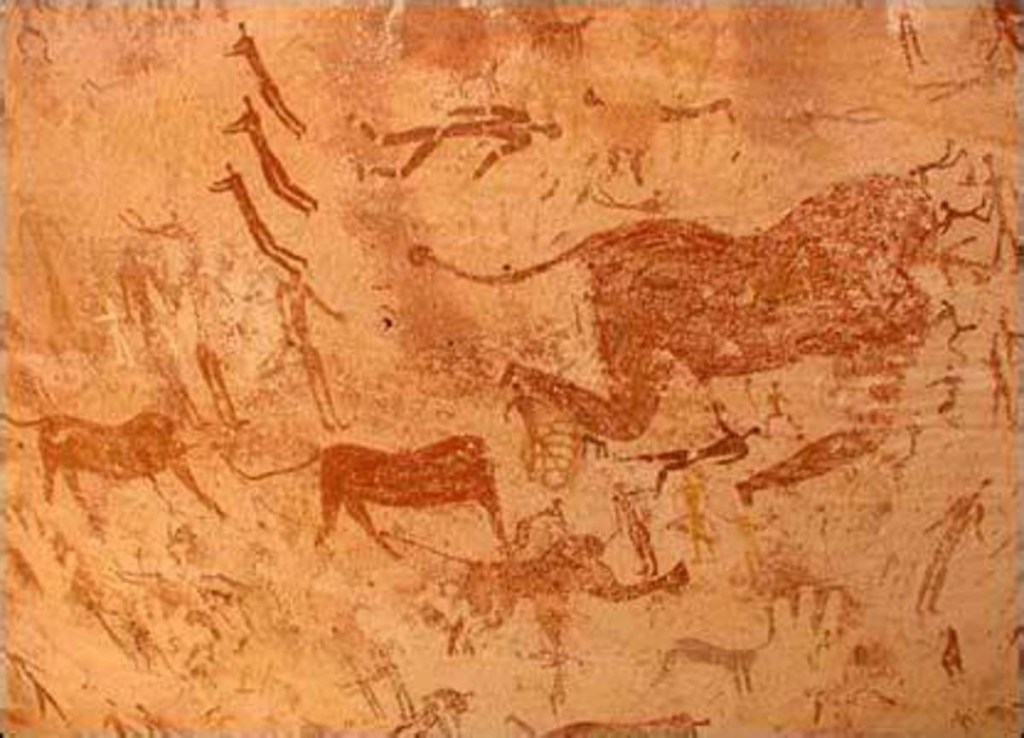
History is the story of humanity and its longstanding education to understand and live in this world. It traces our development from our beginnings to the present… the world as we know it today. How did the hunter-gatherer society learn to hunt, and what did they hunt for prey? How did they learn what was safe to eat, as opposed to what when consumed would end their lives. Prehistoric peoples faced many challenges that we cannot even begin to understand or imagine. Every day could be their last, but those who persevered became the catalyst for who we are today.
Time is an all important part of the historical record. We mark events to measure the passing of time. Family vacation over Christmas; time spent with Gramma and Grandpa over the summer; “we’ll be there in three sleeps.” History is also measured by time, and one of the first examples of this measurement can be linked to the invention of writing, which separates history into two periods… the prehistoric and the historic. The Prehistoric times mark the years that people lived on earth before the invention of writing. The Historic era begins with the invention of writing, records often carved into clay tablets or wood.
Though progress was slow and difficult, the hard work and determination of these people would prevail. The foundations for something bigger than even they imagined were being laid by their hard work and willingness to face the unknown. Would their contributions make a difference? At the time, they had no idea, but as we look back, it is easy to see that whatever contributions were made eventually led to success and the establishment of what we today call “civilization.”
Cradles of Civilization
The Cradles of Civilization
The advent of civilizations gave humanity the ability to settle in one place, but the development of civilizations again required progress. Agriculture enabled humanity to establish homes and produce valuable food sources, but other things were needed for civilizations to thrive and survive as well. People had to be able to communicate with each other, creativity inspired invention and the arts, which were necessary for toolmaking, for enabling the farmers to plow their fields and to reap their harvests. The ability to successfully farm allowed artisans to specialize in certain areas and soon trade became a way of life… each person contributing their talents to the newly established communities.
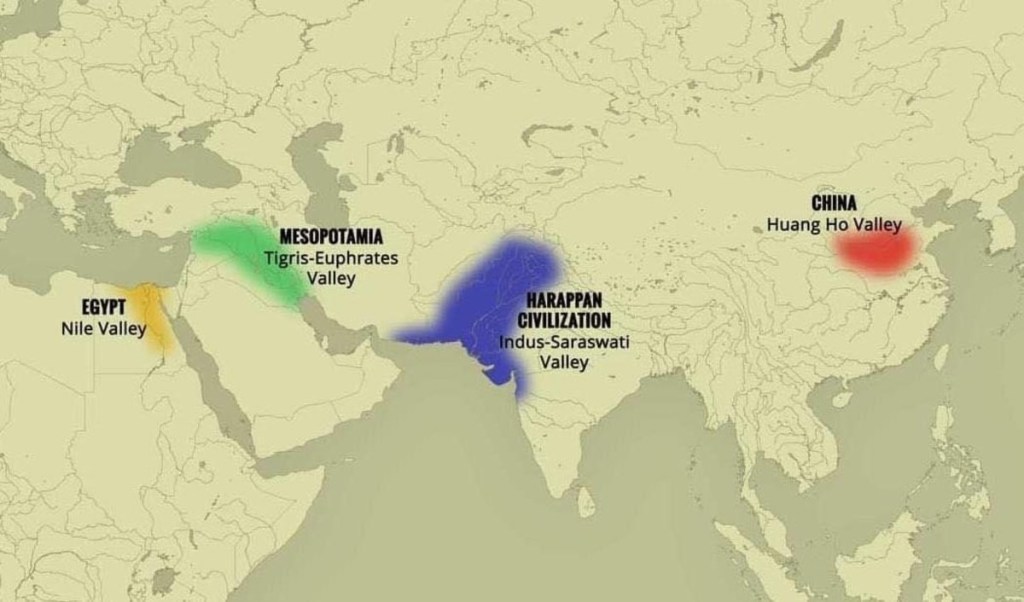
The world’s earliest civilizations grew up in the areas now deemed the “cradles of civilization,” the four lush river valleys that are located in different parts of Asia and Africa. Ancient Egypt is one of these civilizations.
The First Egyptians
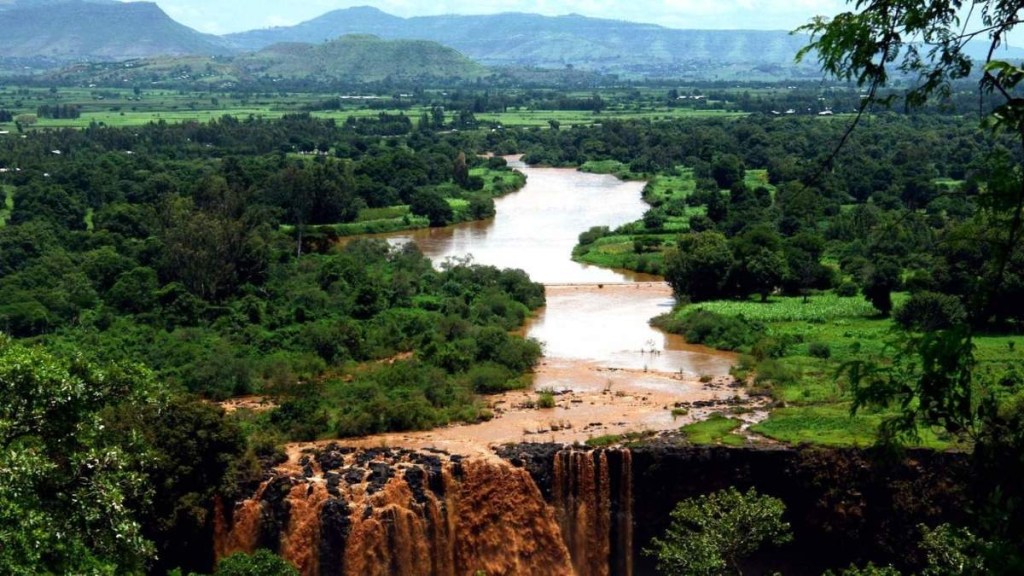
Thousands of years ago, the Valley of the Nile, once a lush, grassy plain in Northern Africa, was inhabited by prehistoric people and numerous prehistoric beasts. Abundant rainfall had created the perfect living conditions in a land that stretched from the Atlantic Ocean to the Red Sea. Over time, however, the rain declined, and the absence of those rains caused this prehistoric haven to become what we now know as the Sahara Desert… the greatest desert in the world.
Luckily, the lack of rain didn’t affect the great Nile River, which was fed by the yearly rains that fell each summer along the Mediterranean coastline, overflowing the Nile’s riverbanks and flooding the area with water, which later receded, leaving in its wake a layer of rich, fertile soil. The marshlands created by the overflow stretched for five to ten miles on either side, and the greenery of the valley lay in sharp contrast to the desert surrounding it. In the valley, shallow basins, ponds, and pools filled with bushes and reeds thrived, providing shelter for the creatures who made their homes in and around the bountiful swampland. Crocodiles, hippos, elephants, snakes, and hyenas were prevalent, wild birds soared as they waited for the mosquitoes, a favorite food source, that hovered above the marsh.
The Nile River Valley, which today is noted to be shaped like a lily, is the flower (a triangular area) known as the delta, which was formed by the river as it regularly received the deposits of soil moved from central Africa during the summer rains, creating the richest soil in Egypt. The stem, the Nile River itself, which is made up of several branches, makes its way to the sea, carrying deposits with it along the way.
During the days of prehistory, the people of Northern Africa were hunters and herders. The land was lush and green, but as already stated, over time these conditions changed with the substantial decrease in rainfall. Some prehistoric peoples remained in the desert, others moved on heading south toward the jungles to hunt and search for greener pastures. Still others moved toward the Nile Valley’s marshes and were later joined by other people from other areas, namely southwestern Asia. These were the people that became the first Egyptians.
Early Egyptian Farming
Early Egyptian Agriculture
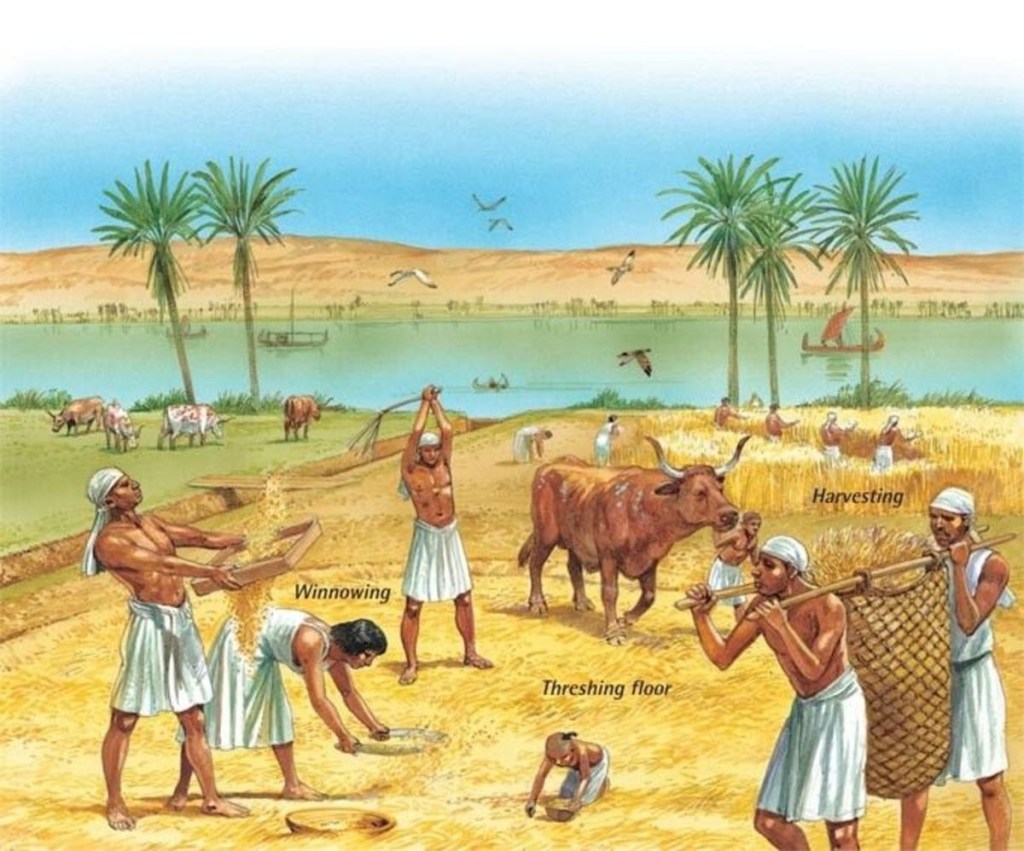
As the first Egyptians settled permanently in the Nile River Valley, their first priority was farming the fertile lands along the Nile. Over time, they faced many problems, which in turn, needed to be solved. The rich black soil was perfect for farming, but farming within the marsh was impossible. Before they could utilize the soil, it was necessary to separate it, thus, the digging began as ditches were created to drain the excess water that collected in the marshes.
With that problem solved, the area’s first farmers quickly learned that the valley wasn’t always green… that before the next rainfalls, the heat and sun would dry and parch the ground into a mass of dust and cracked earth. The vegetation disappeared with the water, leaving nothing behind. So, what did they do? Well, they didn’t give up… they innovated. They used their brains, and they problem-solved, soon realizing that if they were going to survive, they needed to guarantee that they would have a supply of water that would last them from one summer to the next. Innovation and brainstorming led them to discover a way to keep a supply of water by storing it in pools, by digging ditches and canals, by learning to prepare the land so that when the water levels lowered, the water could once again be raised from the canals and ditches for their use… for their survival.
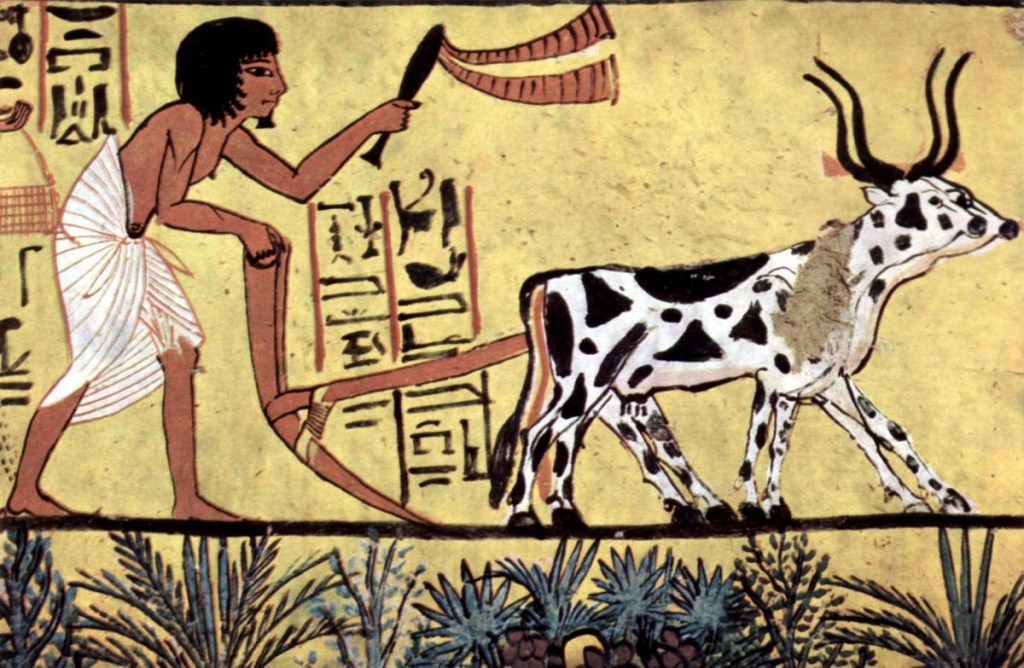
Once their water problems were solved, these early Egyptians had to learn to prepare the soil properly for planting. Initially, sticks and hoes served the purpose, but over time, the wooden plow was invented, using oxen for manual labor. The invention of the wooden plow was a game changer that allowed for larger fields and substantial harvests, but unlike the plows we envision today, the Egyptian plow was light and versatile, its reins tied to the horns of the oxen, rather than strapped over the oxen’s back. This form of plowing was only made possible because of the flooding in the valley, which created conditions that left the simpler task of breaking up the topsoil before planting. An abundance of flax and grains provided the sustenance needed for the people, and it also allowed the people to branch out into other areas. A farmer might have had more grain than he needed, and a hunter might have more meat than his family could consume without spoilage. The beginning of trade made a lasting mark, and most importantly, it allowed for the growth of civilization.
Community and Cooperation
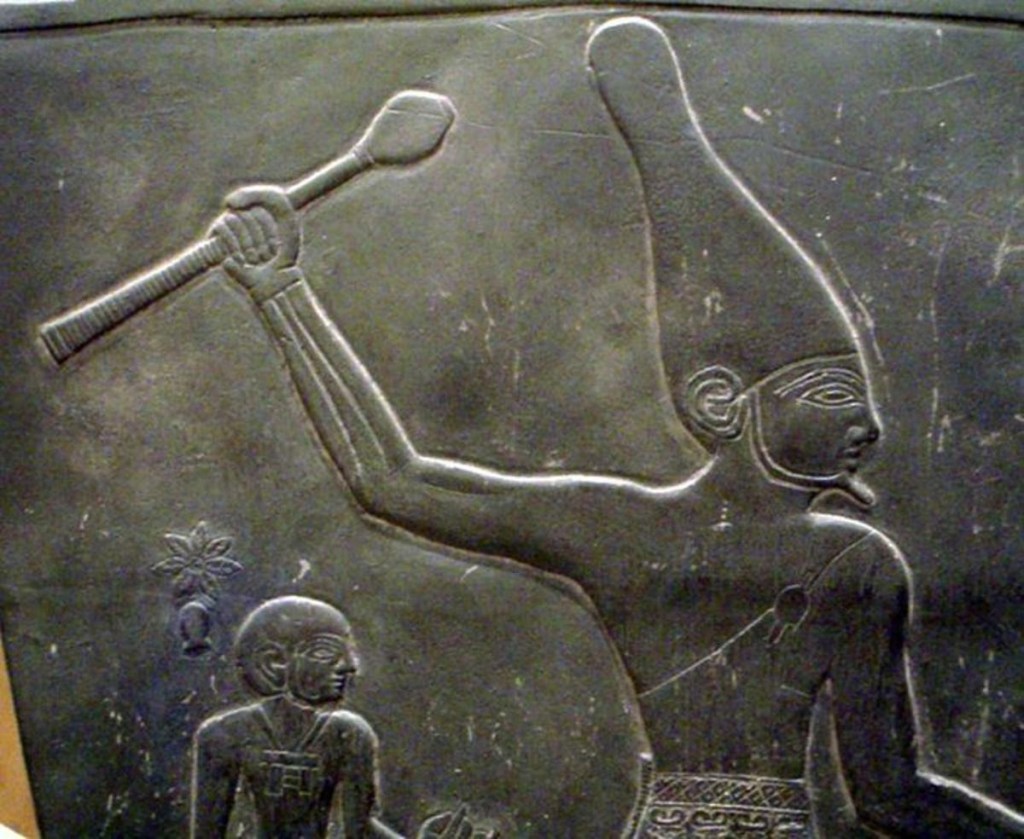
There is no doubt that one of the most integral aspects of civilization is community and cooperation, a desire to be successful, and that everyone takes part in the community’s success. Draining swamps and irrigating the land is not the job of one individual, making sure that the water supply is adequate to sustain the community until the next rainfall requires cooperation. Rules had to be made and enforced to guarantee that supply would sustain the village, which resulted in the early and simplest form of government. Leaders, called chieftains, were chosen by the people to oversee arguments, to de-escalate and settle disputes. At this time, laws and rules weren’t written down, but everyone knew what they were. Later, King Menes, would be the first ruler of the country we now know as Egypt.
King Menes
Egypt’s First King, Menes
Under the rule of King Menes, the first capital of Egypt was established at White Walls, which is located near the apex of the Nile River Delta. It was here that the first great city in the country of Egypt would be built. It was also during this time that hieroglyphic writing came into use for record keeping and communication. Laws and rules were made, followed, and punished if ignored. At this time, ancient Egypt began its chronological journey into what would become known as the Old Kingdom, a kingdom that would surpass all others for years to come.
@ 2026 J.R. Watkins
 History Belongs To Us
Leave a comment