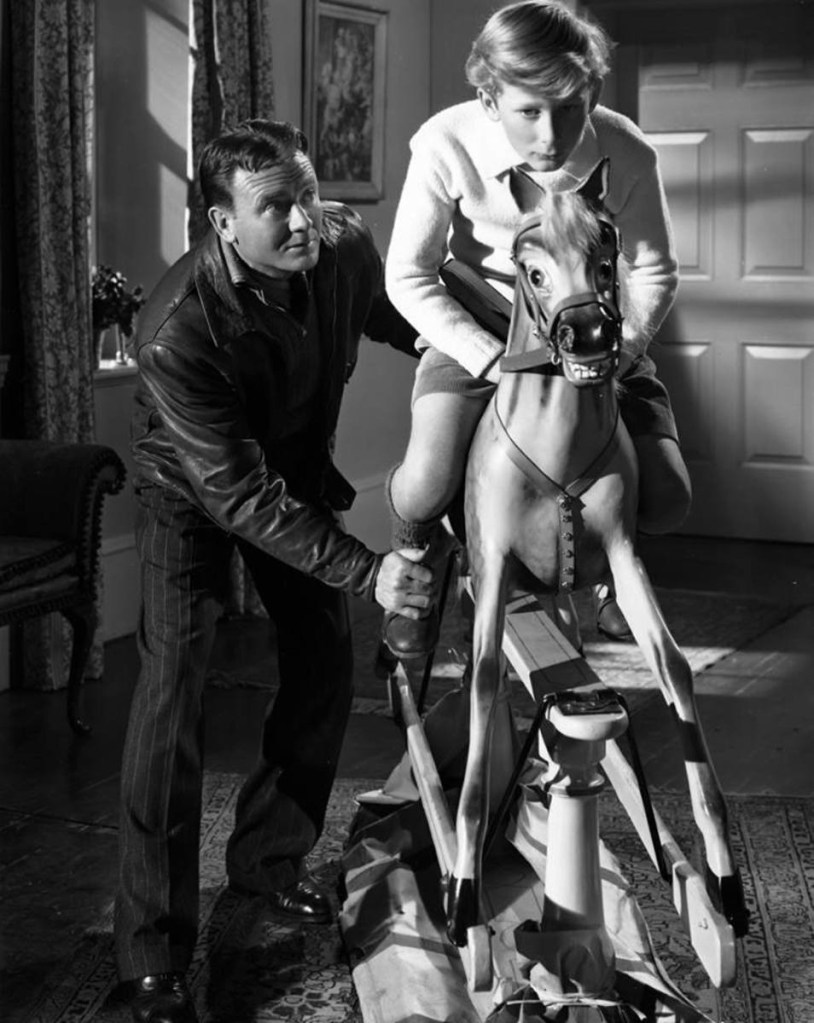
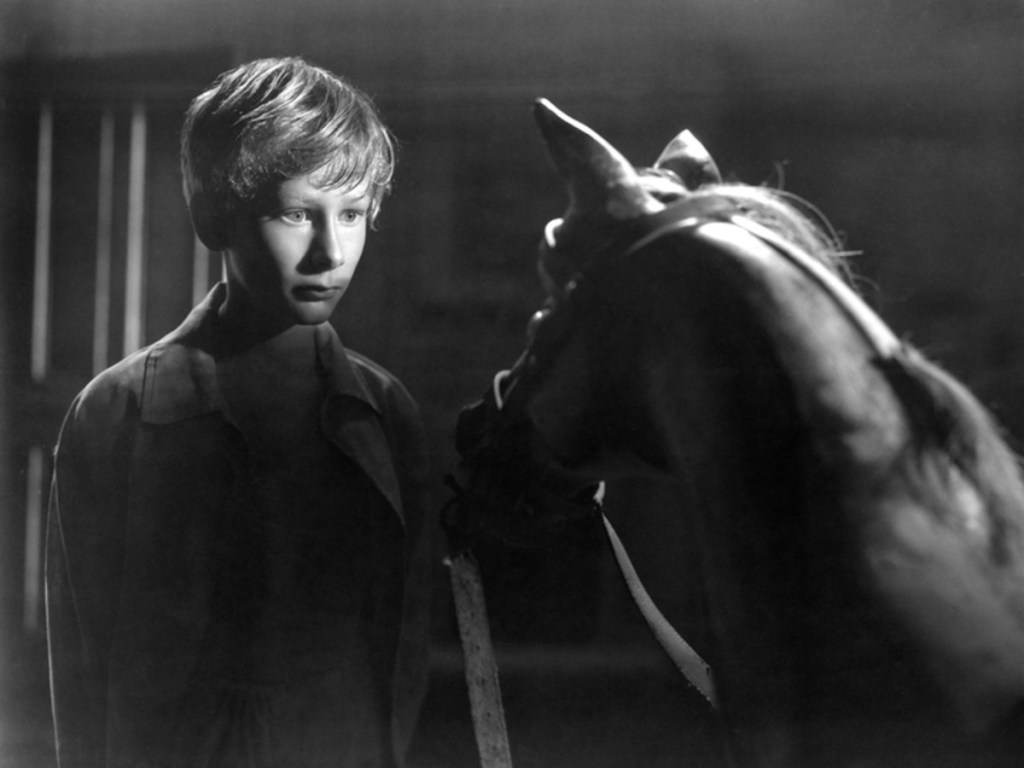
The Rocking Horse Winner, 1950 Film
This week’s choice for Book Club was an extremely easy one to make. Being a huge fan of D.H. Lawrence, his introduction was imminent, but I also acknowledge that his writing can be somewhat difficult for his readers. The Rocking Horse Winner isn’t a wordy short story. It sends a message, it can easily be applied to a reader’s own life experiences, and the characters are made up of people with whom we can easily relate. Everyone has experienced moments of financial worry, and every child has at some point and in some way heard or felt the unspoken words, “There must be more money! There must be more money.”
Our economy cries these words daily, and our government leaders reiterate them on a consistent basis. Families losing their homes, parents seeking jobs that just aren’t available, companies closing their doors. What do our children hear when the reality of economic hardship hits home? Can they handle the words spoken in whispers behind closed doors, loudly at our kitchen tables, and even those that aren’t spoken at all; the ones they see in the depths of our eyes, the whispers that have found a home within the four walls of our existence?
Do they sometimes feel responsible for the financial stress that invades the place in which they live? Do they sometimes take that responsibility far too personally? Should we as parents take more care to filter what we say within their hearing? Do we as parents make them feel an unmerited responsibility for our actions, and is there any justification for sharing our burdens with children who aren’t yet ready to carry them? Well, let’s find out!
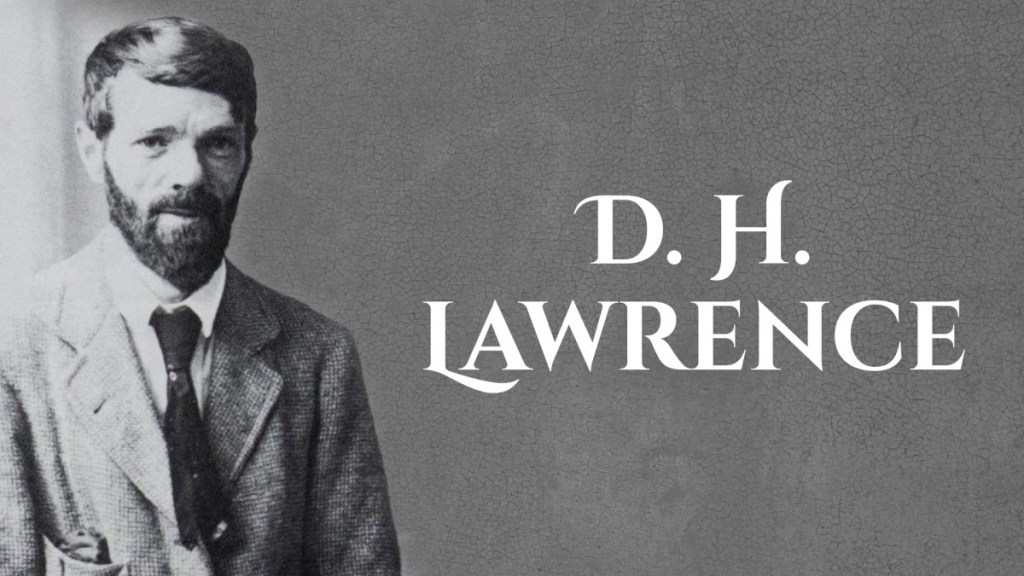
D.H. Lawrence was one of Britain’s greatest 20th Century talents. He is not only one of England’s greatest storytellers, but he was an artist (painter) and poet as well. Known primarily for his writing, many are unaware of the accolades he received for his paintings. Lawrence gained renown for his work in expressionism, especially the works he completed during the 1920s. Unfortunately, he did not receive those well-deserved commendations until after his death in 1930.
Born in England, Lawrence’s young life was affected by both poverty and domestic discord. His parents were very different; his father was a heavy drinking coal miner, who was loved by his friends and family as a cheerful and easy-going man. His mother’s family had fallen onto hard times, but she was well educated. Sadly, it was their differences that brought friction into the marriage, and the couple’s four children couldn’t help but be affected by the stress and lack of affection within their home.
One thing that wasn’t affected by the couple’s marriage was Lawrence’s mother’s love of reading and her belief in education. Four of her children inherited not only her love of words, but her quest for knowledge as well. Lawrence himself was able to pursue his high school education through a scholarship at Nottingham High School. He later went on to work as a clerk and teacher before his career as a writer took off.
D.H. Lawrence both loved—and exhibited fierce loyalty towards—his mother. He was comforted by the fact that his first book of poetry was published the year before his mother’s death (1909). His mother died a year later, assisted by her son’s administration of an overdose of sleeping medication. I wonder what his stance would be on assisted euthanasia today.
Lawrence’s life was filled with controversy and travel. It was during 1912 that he both met and fell in love with his future wife Frieda von Richthofen… the only impediment to their eventual marriage being that Frieda was already the wife of another man, and the mother of three children. Frieda left her family for Lawrence, and it would be two years before they were finally able to wed, but that wasn’t where their controversy ended. The advent of WWI found them unable to obtain passports and accused of being German spies. It wasn’t until the year 1919 that they were allowed to leave and begin what was to be a life of extensive travel.
Lawrence is best known for his novel, Lady Chatterly’s Lover, the story of an affluent woman who embarks on an affair with a family servant (laborer on her estate). This novel, once banned in both the UK and the United States on the premise that it was pornographic, has gone on to become a classic. Other famous works by D.H. Lawrence are Women in Love (1920) and The Man Who Died (1928), which is rightfully considered a blasphemous account of Jesus’ resurrection and actions after death.
The Rocking Horse Winner: A Summary
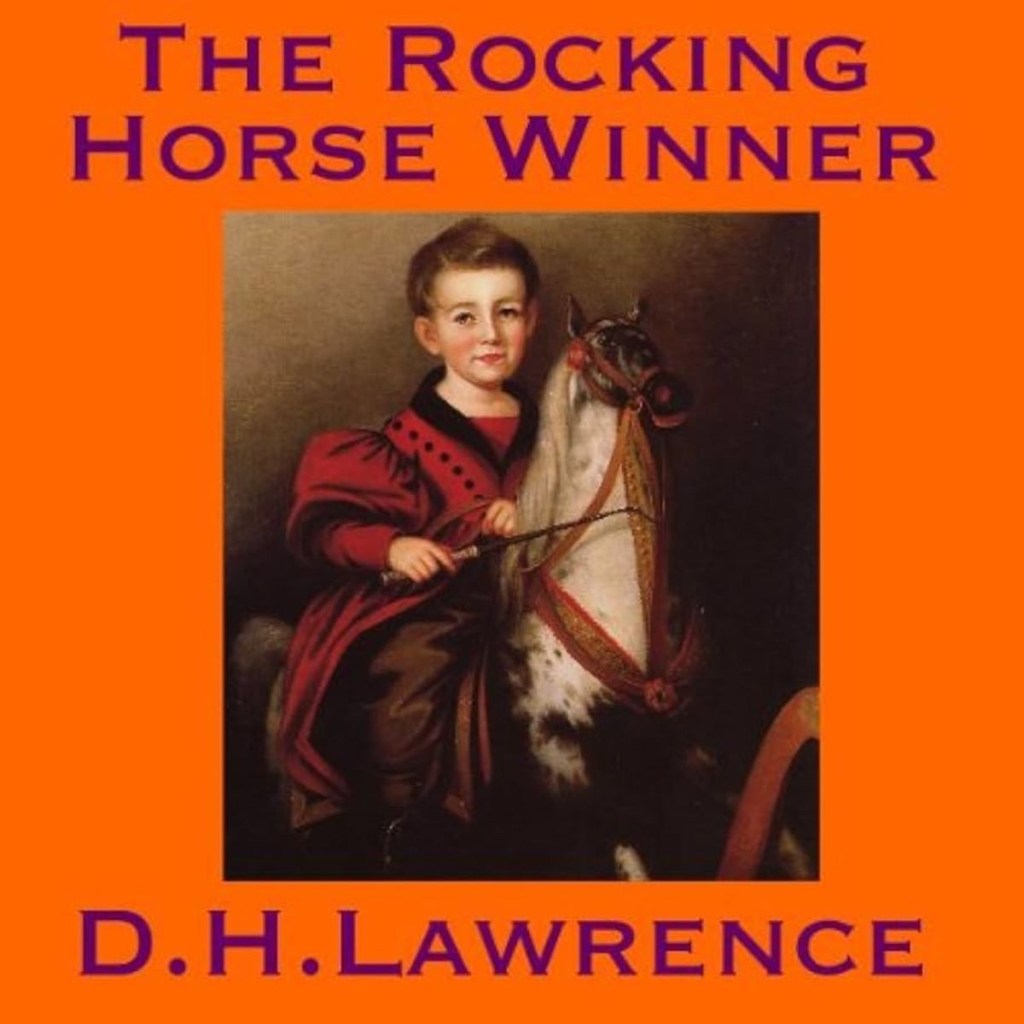
Our story begins with the description of a woman; a woman who was fortunate enough to have been born into a wealthy family. This woman has had all of the advantages that wealth has to offer. She was young, she was beautiful, and life was good. Her childhood had been blessed with innocence and luxury, and her marriage was rare in that she’d had the opportunity and freedom to marry for love. You’d think she’d be happy; wouldn’t you?
Our pretty picture doesn’t last very long. The love she had once felt for her husband is said to have turned to dust, she’s resentful of her children because she feels as if they’ve been forced upon her, and it is said that she could not love them, but yet, she covers up that resentment because she believes it to be her own fault that she feels this way. Her heart is hard, but no one is the wiser because through her guilt and overcompensation for the feelings she lacks; she appears to be the “perfect mother,” a mother who adores her children, but the children, they know better, and they each of them read the same message within the other’s eyes. The children could feel it, even if no one else could see it.
The family lived well. They had all that they needed and then some, but there was never enough money. Both the mother and the father had small incomes, and those incomes were adequate for taking care of the family’s needs, but they weren’t enough, at least as far as the parents were concerned. It was important to maintain a certain social position, and for the parents, even if it wasn’t actually necessary, it was important. The parents wanted to maintain the place they held in society; they didn’t want to give it up, and they weren’t about to. The father suffered from lost opportunities, and the mother suffered from her attempts to create opportunities, but their failures never served to change their expectations or their behaviors. Living in luxury was due them, expensive taste was natural, and the continuous stress they acquired because of their continual acquisition of things led to the whispers that permeated their home, “There must be more money! There must be more money!”
At first, the whispers may have been so softly spoken that only the parents could hear them, but eventually they became just loud enough for all to hear, particularly the children. The house was speaking in whispers all of the time; it spoke at Christmas, it spoke in the nursery, and it spoke through the toys. It even seemed as if the toys themselves were smirking behind their unreal eyes……….. that they were laughing. No one ever talked about the whispers, but they all heard them, and they would each of them look amongst themselves with questioning eyes that required no answer; the fact that they all could hear was evident without ever having to speak out loud.
As time goes on, Paul, the oldest of the children, begins to question his mother about the little things that stymie him. He wonders why they have no car, why his mother refers to them as the poor members of the family, and he displays a unique curiosity as to what makes them the poor relations. His mother responds that she supposes their financial woes are due to his father’s lack of luck, and in turn, Paul begins his quest to understand the meaning of “lucky” and proclaims himself to be just that, and when his mother questions where that self-assured knowledge comes from, he asserts, “God told me.”
With that, Paul begins his quest to prove his luck. As his sisters play on the nursery floor, Paul mounts the rocking horse that had once murmured through its creaking springs and the arch of its neck, “There must be more money!” Paul rides, and then he rides some more, trying to find the evasive luck he avows to have, and in turn, he ceaselessly begins to hurl himself into another universe. He becomes caught up in a ride that becomes more frenzied with each trip, and the people around him begin to notice his glassy eyes, that the whip he’s requested from his uncle is used ever more violently in order to force the rocking horse to take him where he needs to go, but where is he going? Why does he look into the horse’s eyes questioningly, and what is the rocking horse’s reply?
When Paul’s Uncle walks in to see him riding the horse one day, he is visibly upset by the aggression the boy uses with what is supposedly his most treasured toy in the nursery. When he questions Paul, the boy rambles on about the races, gambling, and the money he’s both wagered and won by teaming up with the gardener, who has been placing Paul’s bets. Uncle Oscar then speaks with the gardener and discovers that they are in fact partners, and that the gambling, for the time being, is paying off. Shocked at the boy’s winnings and luck, the uncle fails to warn Paul of the dangers in gambling, but rather, becomes his partner. Paul is lucky, just as he’s proclaimed.
THE BIRTHDAY GIFT THAT JUST WASN’T GOOD ENOUGH!
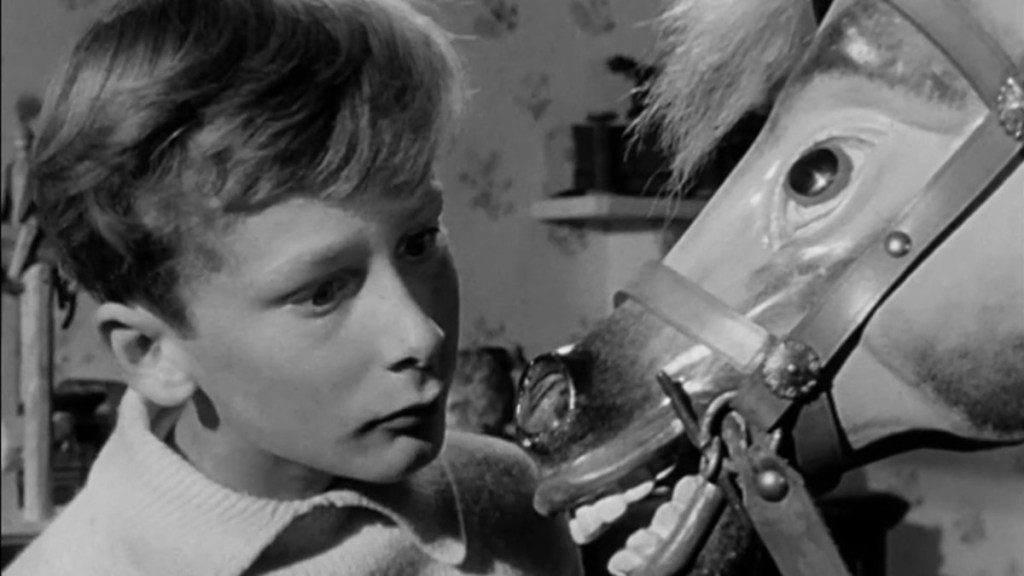
As Paul’s winnings begin to pile up his uncle questions what he will do with them, and Paul really can’t answer. He admits that his “need” to have it started with his mother because she was unlucky, because his father was unlucky, and because he believed that maybe, just maybe, his own luck would stop the house from whispering. He then equates the whispering to other things………. things like people laughing at you when you’re not looking. Uncle Oscar understands how the boy feels, and yet, he doesn’t understand Paul’s desire that his mother not discover his “luck.” Paul doesn’t want her to know, but he does want her to have the money, and he still wants what is his most fervent wish; he wants the house to be quiet.
Paul’s need to quiet the house and to bring his mother a sense of happiness or even relief are not to be realized. He gives five thousand pounds of his winnings to his uncle in order to set up a birthday gift for his mother; a five-thousand-pound birthday gift to be spread out over five years………. but is it enough?
The post comes, the birthday gift has arrived, and Paul knows this because he has waited. He’s waited for its arrival, and he has waited in order to see her reaction, but he didn’t get what he was waiting for. His mother opened the letter; she read it, and then she hid it at the bottom of the pile. Paul didn’t understand. There was no understanding of her reaction nor of the hard look that shadowed her face. She wasn’t happy. Why wasn’t she happy?
The rest of the story is for you to read. It’s about a young boy, and the road he rides on a rocking horse. It’s about the horse that he believes holds the magic that makes him a winner, that makes him lucky, and it’s about a mother whose heart may have held just a little love inside after all. Does she find it, and if she does, is she too late?
BRILLIANT YOUNG MINDS
Our group discussion was lively to say the least. The students were very comfortable with this story, and it was quite evident in their responses that they understood Lawrence’s message.
We began with what was a very short compare and contrast session. The children immediately picked up on the similarities between The Rocking Horse Winner and The Cut Glass Bowl. They touched on what they believed the two stories have in common; the time period, the detached wife, the fact that the “children” in each story had a distinct effect upon their mothers, and the fact that both couples were facing some sort of financial hardship.
Then they marked the differences. Fitzgerald’s couple had married for convenience without love; Lawrence’s couple had married for love, and yet, both marriages disintegrated for completely different reasons. One woman married for a love that had “turned to dust”, and the other married for what was seen as social acceptability and had then fallen in love. Neither of our female characters had a happy ending, but both endings did have one very important similarity………. but you’ll have to read them both to find out; I’m not telling.
As mothers, the two women were completely different; in The Cut Glass Bowl, we have a mother who completely devotes herself to raising her children. Whereas The Rocking Horse Winner portrays a mother without love and feeling, but a mother nonetheless, a mother whose actions reap the reactions that make this short story a classic.
The main difference between the two female characters in these stories is the way that the students reacted to their portrayals. Where the students had given Fitzgerald’s Evelyn their complete compassion, they had no compassion at all for Paul’s mother. They quite frankly found nothing likable about her. Ironically, she was able to muster a small amount of sympathy towards the end, but it didn’t last very long, and we’re not going there.
The kids had a lot of fun dissecting the stories, but I hadn’t originally planned on the conversation moving in that direction, and it took a while to get them back on track. The second part of our discussion revolved around the whispering of the house. Can a house whisper? Are words able to float through rooms after they’ve been spoken? Are there words that can’t be taken back, words that hover and haunt the places where we live, and can they drown the silence? Are there times when it’s impossible to find silence?
Families

I sometimes feel sad that so many of our discussions this year revolve around the economy and the financial upheaval so many of today’s families are facing, but what’s a girl to do? It’s reality, and the kids are well aware of the changes, challenges, and hardships that their families are going through. So, the unanimous answer to all of the preceding questions was an undeniable “yes!”
Houses whisper the words of conversations that parents so often try to hide, and they also reverberate with arguments that can’t be hidden. The things we utter do not disappear after they’ve been spoken; our children think about them at bedtime, they sometimes dream of them when they’re frightened by the volume at which they’re spoken, and yes, they can hover and haunt the places in which we live. Children are not immune to their parents’ words and actions, and they will often react with words and actions of their own. The biggest problem for the children is that they feel their parents are so wrapped up in the worrying and the whispers that they’re not paying attention to what it’s doing to their families. Each of the children understood why Paul reacted, why he felt that he needed to be “lucky,” and why he wanted to “still” the whispers in the house. What they couldn’t understand was how nobody was able to truly see what Paul’s quest was doing to him. His strange behaviors were noted, but they were never really addressed. Why?
Paul’s mother once again came under fire because of the “birthday gift” he anonymously sent her through the family lawyers. The kids understood that the mother was unaware of where the funds came from, but they were appalled at the selfishness she showed by hiding it and then going on to request she have it all. It wasn’t enough, and the boy who had set out to prove his luck, give some sense of relief to his mother, and most important of all “stop the whispers,” only heard them grow louder. He gained nothing with his gift except the need to keep riding in “the rocking horse race….” the need to get there, but where was there, and would he ever really find it?
Our discussion concluded with the children’s thoughts on communication within the family. They talked about the fact that although they need their parents to talk to them about certain things, they don’t need to know everything. They don’t want to know everything! Each of them is acquainted in one way or another with the phrase, “There must be more money,” but they don’t want to hear the details, the words are enough in themselves. More than that, they hate the fighting that money sometimes brings into their homes. Parents argue about money… they claimed that as a fact, and they feel that these types of arguments are universal, but they don’t want to hear them, and they don’t want to hear their parents lay blame, not on each other, and not on them.
It’s really quite simple, and an example given by one of the girls was none other than the purchase of a pair of shoes. Her mother had taken her shopping, and they had made that trip for no other reason than to buy a pair of shoes. Her mother had said nothing in the store, nothing about the style, the color, and most certainly nothing about the cost, but when they got home the shoes caused an argument that continues to this day. She didn’t care about those specific shoes, and she didn’t need them, and had she known that their purchase would cause discord in the family, between her parents; she would have left them on the shelf. The shoes were not important, but the fact that she no longer likes them and feels guilty about having them is. She agrees that houses can whisper because she hears the whispers from the inside of her closet, and who’s to tell her she’s wrong? Not me, that’s for sure!
 History Belongs To Us
Leave a comment